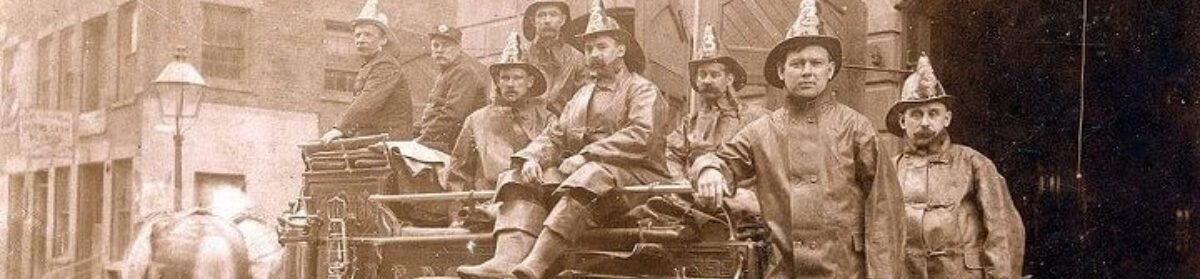
A new chapter in preserving and interpreting America’s fire service history will begin later this month with the release of the inaugural issue of The Fire Heritage Review: The Journal of Fire Service and Fire Protection History.
Published by the National Fire Heritage Center, The Fire Heritage Review is an annual peer-reviewed journal devoted to preserving and advancing the study of the history of America’s fire service and fire protection disciplines. It is intended as a forum where historians, researchers, firefighters, fire protection professionals, archivists, and others interested in fire heritage can share carefully researched work and add to the historical record.
The response to the journal’s first call for manuscripts demonstrated that there is considerable interest in doing just that. Twelve manuscripts representing a broad range of subjects and perspectives were submitted for consideration. Following editorial and peer review, four were selected for publication in the inaugural issue.
Articles in this Issue
Together, those four articles illustrate just how broad the field of fire-service history can be.
From John Brown’s Raid to the Firehouse
Retired Chief Clarence “Chip” Jewell takes readers back to Frederick, Maryland, on the eve of the Civil War in “Call to Arms: Fire Company Militia Units of Frederick, Maryland.”
Jewell uncovers a little-known episode in which militia companies associated with Frederick’s three volunteer fire companies were called to Harpers Ferry during John Brown’s 1859 raid. Approximately 175 members of the Frederick units traveled by railroad to the scene, placing local volunteer firefighters at one of the pivotal events leading toward the Civil War.
Jewell brings more than 50 years of fire service experience to the subject. A retired deputy chief/director of the Frederick County Volunteer Fire & Rescue Services, he is a founding member of the National Fire Heritage Center, president of the Frederick County Fire & Rescue Museum, and the author of several works on Frederick County fire-service history.
Innovation in a Decade of Adversity
Fire apparatus historian Anthony G. Buono examines a very different period in “The 1930s: A Decade of Innovations.”
The Great Depression devastated municipal budgets and the fire-apparatus industry. Yet Buono shows that the decade also produced remarkable technological change. His article follows developments in aerial ladders, larger-capacity pumping apparatus, streamlining and safety, and the emergence of specialized rescue vehicles.
The story is not merely about old fire trucks. It demonstrates how economic adversity helped drive changes in apparatus design and function that increased firefighters’ capabilities and ultimately contributed to the much broader range of services performed by modern fire departments.
Buono brings both historical expertise and firsthand fire service experience to his work. An attorney in private practice in New York, he served for 20 years as a volunteer firefighter and chairs the SPAAMFAA Archives Committee. He has written extensively about fire apparatus and firefighting history.
Preserving the Voices Behind the History
Sometimes the most important historical records are not written records at all.
Retired Greensboro Fire Department Battalion Chief Larry Cockman explores that idea in “Preserving Our Legacy: The Greensboro Fire Department’s Oral History Initiative.”
The Greensboro Fire Department and Greensboro Firefighter Historical Society have undertaken an ambitious effort to record the experiences of retired firefighters before those memories disappear. To date, the project has recorded interviews with 107 retired firefighters representing more than 2,900 cumulative years of service.
Cockman makes an important distinction: official records can document what happened, but oral histories can preserve how and why events occurred, the realities of everyday firehouse life, changes in practices, and the personal dimensions of service that incident reports and departmental records rarely capture.
The result is more than a history of one department. Cockman presents a model that departments around the country can adapt to begin preserving their own institutional memory before those firsthand voices are lost.
Insurance and Two Centuries of Fire Protection
Rounding out the four peer-reviewed articles is John A. Frank, P.E., FSPE, CFPS, whose “Insurance Role in Industrial Fire Protection” takes a wide-ranging look at a relationship that has helped shape fire protection for centuries.
Frank traces the connections between insurance and fire protection from early maritime and property insurance through the Industrial Revolution and into the modern era. Along the way, he examines insurance-company fire brigades and salvage corps, Sanborn maps, automatic sprinklers, engineering standards, Underwriters Laboratories, Highly Protected Risk concepts, and contemporary research into emerging hazards.
His central argument is an important one: insurers have historically done much more than compensate owners after a fire. For roughly two centuries, they have also helped drive efforts to prevent fires, reduce losses, improve building protection, and encourage technological innovation.
Frank approaches the subject with considerable professional experience. He is AXA XL Risk Consulting’s Property Loss Prevention Center of Expertise Leader and previously served as a U.S. Air Force Fire Protection Specialist and assistant fire chief.
Building a Peer-Reviewed Forum for Fire History
Behind these articles is another important part of the new journal: a formal peer-review process.
The inaugural manuscripts were evaluated by a panel whose members bring backgrounds in fire protection engineering, emergency-services leadership, scholarship, writing, and fire-service history. The panel reviewed submissions for historical accuracy, methodological soundness, relevance, and contribution to the field while providing authors with constructive feedback.
That process is intended to make Fire Heritage Review something distinctive: a publication that combines the standards of historical scholarship with the knowledge and experience found within the fire service community.
The inaugural issue also recognizes a leader who helped shape that tradition. The NFHC Board of Directors has dedicated the first journal to Ronny J. Coleman, the Center’s first president, prolific author, fire-service leader, and advocate for fire protection, prevention, education, and the preservation of professional knowledge.
The timing is especially appropriate as the National Fire Heritage Center joins the nation in commemorating its 250th anniversary. As NFHC President Lynn White notes in her message for the inaugural issue, understanding how fire protection developed over the nation’s history can help us appreciate not only where the fire service has been, but why its practices have changed over time.
Watch for the First Issue
In just a few weeks, readers will have their first opportunity to explore Fire Heritage Review.
But the publication of Volume 1 is intended to be a beginning, not an ending.
The National Fire Heritage Center is already looking toward future issues and encourages historians, fire-service practitioners, researchers, archivists, students, and others engaged in serious study of fire and fire protection history to consider contributing their own research. The journal welcomes work examining historic incidents, technological change, organizations and institutions, influential individuals, firefighting practices, fire prevention, and the many other subjects that make up America’s fire heritage.
Support the National Fire Heritage Center
If you value our mission, we invite you to make a donation to the National Fire Heritage Center. Your contribution helps preserve and share vital knowledge that informs the future of fire protection. Click below to donate and make an impact today.


