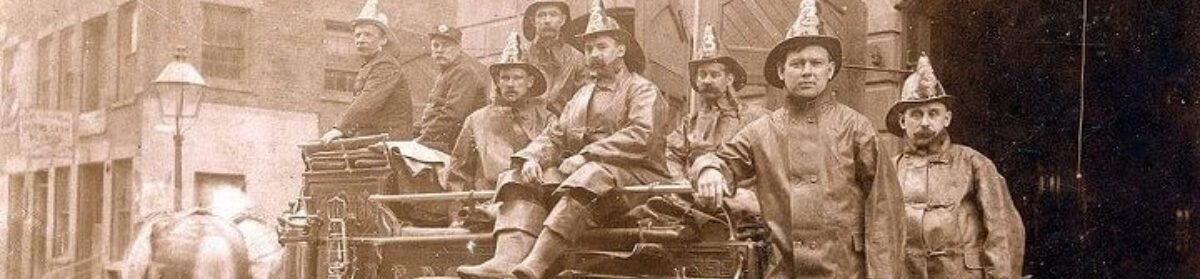
We are in the final production stages of the inaugural issue of the Fire Heritage Review. Our team is working closely with the designers and printer to complete the last details and prepare the journal for release. We will share news about its availability soon.
Author: NFHC
The blog of the National Fire Heritage Center
We Promised We’d Never Forget
Doug Meil Examines 19th-Century Public Safety Communications

Cities in the late 1800s were implementing technologies that seem surprisingly modern—telegraph‑based alarm networks, centralized dispatching, and early forms of automated public‑safety communication. In a new long‑form feature, author Doug Meil explores how these systems worked, why they mattered, and how they shaped the development of public safety communications in the United States.
Meil traces the evolution of municipal telegraph networks, the engineering concepts behind alarm boxes and signal circuits, and the rise of centralized control rooms that coordinated fire and police response. It’s an impressive look at the technical and organizational foundations of systems that eventually led to today’s 911 and modern fire alarm communications.
As Meil notes, “Call boxes might be history, but they should not be forgotten.”
Read the full article: High‑Tech 19th‑Century Public Safety Communication

9/11, 25 Years Later: Fire Service Lessons, Sacrifice & Shared Memory
Dr. Lynn White, President
While it’s been 25 years since we experienced the first attack on our nation on September 9, 2011, I remember when the first plane crashed into the World Trade Center; we thought it was an accident with great potential loss. Then the second tower was struck by another plane, and we knew it was not an accident. Our nation was thrust into a series of incidents that reshaped our national security and emergency response. It also had a disastrous impact on many families.
The first words David White spoke after hearing the news were, “Over 300 emergency responders will die today.” I asked what he based that number on, and he said that is how many emergency responders would be sent to rescue and, if possible, extinguish fires. He knew many of the emergency responders because he had spent a lot of “ride out” time with them each September.
Before attending the 2024 NFHC Board Meeting in Cumberland, I visited the bell tower built to honor those who gave their lives to crash the fourth plane in Pennsylvania before it could be flown to its target. A bell sounds for each voice, reminding us that there are times when we must step up to save others, even if it costs us our lives.
While the memories of 9/11 are 25 years old, they keep playing in our minds, keeping us alert to dangers and ready to respond when necessary. I’m also reminded that preserving the history of America’s fire services and disciplines requires an individual commitment to recalling and sharing lessons learned from past emergency responses. As individuals or team members, we are all part of a greater team: America’s fire services and disciplines, and the communities where we live and work. Share with others reading this blog how the 9/11 events have impacted your vision of how this event from the past is impacting your life now and its impact on our future.
Coming Soon: The Inaugural Issue of The Fire Heritage Review
A new chapter in preserving and interpreting America’s fire service history will begin later this month with the release of the inaugural issue of The Fire Heritage Review: The Journal of Fire Service and Fire Protection History.
Published by the National Fire Heritage Center, The Fire Heritage Review is an annual peer-reviewed journal devoted to preserving and advancing the study of the history of America’s fire service and fire protection disciplines. It is intended as a forum where historians, researchers, firefighters, fire protection professionals, archivists, and others interested in fire heritage can share carefully researched work and add to the historical record.
The response to the journal’s first call for manuscripts demonstrated that there is considerable interest in doing just that. Twelve manuscripts representing a broad range of subjects and perspectives were submitted for consideration. Following editorial and peer review, four were selected for publication in the inaugural issue.
Articles in this Issue
Together, those four articles illustrate just how broad the field of fire-service history can be.
From John Brown’s Raid to the Firehouse
Retired Chief Clarence “Chip” Jewell takes readers back to Frederick, Maryland, on the eve of the Civil War in “Call to Arms: Fire Company Militia Units of Frederick, Maryland.”
Jewell uncovers a little-known episode in which militia companies associated with Frederick’s three volunteer fire companies were called to Harpers Ferry during John Brown’s 1859 raid. Approximately 175 members of the Frederick units traveled by railroad to the scene, placing local volunteer firefighters at one of the pivotal events leading toward the Civil War.
Jewell brings more than 50 years of fire service experience to the subject. A retired deputy chief/director of the Frederick County Volunteer Fire & Rescue Services, he is a founding member of the National Fire Heritage Center, president of the Frederick County Fire & Rescue Museum, and the author of several works on Frederick County fire-service history.
Innovation in a Decade of Adversity
Fire apparatus historian Anthony G. Buono examines a very different period in “The 1930s: A Decade of Innovations.”
The Great Depression devastated municipal budgets and the fire-apparatus industry. Yet Buono shows that the decade also produced remarkable technological change. His article follows developments in aerial ladders, larger-capacity pumping apparatus, streamlining and safety, and the emergence of specialized rescue vehicles.
The story is not merely about old fire trucks. It demonstrates how economic adversity helped drive changes in apparatus design and function that increased firefighters’ capabilities and ultimately contributed to the much broader range of services performed by modern fire departments.
Buono brings both historical expertise and firsthand fire service experience to his work. An attorney in private practice in New York, he served for 20 years as a volunteer firefighter and chairs the SPAAMFAA Archives Committee. He has written extensively about fire apparatus and firefighting history.
Preserving the Voices Behind the History
Sometimes the most important historical records are not written records at all.
Retired Greensboro Fire Department Battalion Chief Larry Cockman explores that idea in “Preserving Our Legacy: The Greensboro Fire Department’s Oral History Initiative.”
The Greensboro Fire Department and Greensboro Firefighter Historical Society have undertaken an ambitious effort to record the experiences of retired firefighters before those memories disappear. To date, the project has recorded interviews with 107 retired firefighters representing more than 2,900 cumulative years of service.
Cockman makes an important distinction: official records can document what happened, but oral histories can preserve how and why events occurred, the realities of everyday firehouse life, changes in practices, and the personal dimensions of service that incident reports and departmental records rarely capture.
The result is more than a history of one department. Cockman presents a model that departments around the country can adapt to begin preserving their own institutional memory before those firsthand voices are lost.
Insurance and Two Centuries of Fire Protection
Rounding out the four peer-reviewed articles is John A. Frank, P.E., FSPE, CFPS, whose “Insurance Role in Industrial Fire Protection” takes a wide-ranging look at a relationship that has helped shape fire protection for centuries.
Frank traces the connections between insurance and fire protection from early maritime and property insurance through the Industrial Revolution and into the modern era. Along the way, he examines insurance-company fire brigades and salvage corps, Sanborn maps, automatic sprinklers, engineering standards, Underwriters Laboratories, Highly Protected Risk concepts, and contemporary research into emerging hazards.
His central argument is an important one: insurers have historically done much more than compensate owners after a fire. For roughly two centuries, they have also helped drive efforts to prevent fires, reduce losses, improve building protection, and encourage technological innovation.
Frank approaches the subject with considerable professional experience. He is AXA XL Risk Consulting’s Property Loss Prevention Center of Expertise Leader and previously served as a U.S. Air Force Fire Protection Specialist and assistant fire chief.
Building a Peer-Reviewed Forum for Fire History
Behind these articles is another important part of the new journal: a formal peer-review process.
The inaugural manuscripts were evaluated by a panel whose members bring backgrounds in fire protection engineering, emergency-services leadership, scholarship, writing, and fire-service history. The panel reviewed submissions for historical accuracy, methodological soundness, relevance, and contribution to the field while providing authors with constructive feedback.
That process is intended to make Fire Heritage Review something distinctive: a publication that combines the standards of historical scholarship with the knowledge and experience found within the fire service community.
The inaugural issue also recognizes a leader who helped shape that tradition. The NFHC Board of Directors has dedicated the first journal to Ronny J. Coleman, the Center’s first president, prolific author, fire-service leader, and advocate for fire protection, prevention, education, and the preservation of professional knowledge.
The timing is especially appropriate as the National Fire Heritage Center joins the nation in commemorating its 250th anniversary. As NFHC President Lynn White notes in her message for the inaugural issue, understanding how fire protection developed over the nation’s history can help us appreciate not only where the fire service has been, but why its practices have changed over time.
Watch for the First Issue
In just a few weeks, readers will have their first opportunity to explore Fire Heritage Review.
But the publication of Volume 1 is intended to be a beginning, not an ending.
The National Fire Heritage Center is already looking toward future issues and encourages historians, fire-service practitioners, researchers, archivists, students, and others engaged in serious study of fire and fire protection history to consider contributing their own research. The journal welcomes work examining historic incidents, technological change, organizations and institutions, influential individuals, firefighting practices, fire prevention, and the many other subjects that make up America’s fire heritage.
Support the National Fire Heritage Center
If you value our mission, we invite you to make a donation to the National Fire Heritage Center. Your contribution helps preserve and share vital knowledge that informs the future of fire protection. Click below to donate and make an impact today.

History of Fire Extinguishers
by Willie G. Shelton, Jr., CEM, FIFireE
Fire extinguishers developed from a basic human need: stopping small fires before they became disasters. Early communities relied on water, sand, blankets, and bucket brigades, but as cities grew and buildings became more crowded, inventors began searching for faster, portable, and more reliable ways to fight fires.
Early Fire Control
Before portable extinguishers existed, people fought fires with whatever materials were available. Ancient and medieval communities used buckets of water, sand, wet cloth, and simple hand pumps. These methods could help with small flames, but they depended heavily on speed, manpower, and access to water.
The First Fire Extinguishers
One of the earliest recorded fire-extinguishing devices was patented in England in 1723 by Ambrose Godfrey. It used a chamber of gunpowder to scatter extinguishing liquid over a fire. Although dangerous by modern standards, it showed an important new idea: a device could release a fire-suppressing agent automatically or quickly.
In the early 1800s, British inventor George William Manby created one of the first practical portable fire extinguishers. His device used compressed air to discharge a potassium carbonate solution, allowing a person to attack a fire more directly and immediately than with bucket brigades.
19th- and 20th-Century Improvements


During the late 1800s, soda-acid extinguishers became common. These devices produced carbon dioxide through a chemical reaction, creating pressure that forced liquid out of the cylinder. Later designs introduced foam, dry chemical powders, carbon dioxide, and other agents suited for different kinds of fires.
Modern Fire Extinguishers
Modern fire extinguishers are designed for specific fire classes, such as ordinary combustibles, flammable liquids, electrical fires, and cooking oils. They are safer, more reliable, and easier to operate than earlier models. Regulations, inspections, and clear labeling have also made extinguishers a standard part of homes, schools, offices, factories, and public buildings.
Key Milestones
- Ancient and medieval periods: People used buckets, sand, wet cloth, and hand pumps to control fires.
- 1723: Ambrose Godfrey patented an early fire-extinguishing device in England.
- Early 1800s: George William Manby developed a practical portable extinguisher using compressed air.
- Late 1800s: Soda-acid extinguishers became widely used.
- 20th century: New extinguishing agents, including foam, carbon dioxide, and dry chemicals, improved fire safety.
- Today: Extinguishers are classified by fire type and are required in many buildings as part of modern safety systems.
Conclusion
The history of fire extinguishers shows how practical invention, chemistry, and public safety needs came together. From buckets of water to specialized portable devices, extinguishers have become one of the most important tools for preventing small fires from turning into major emergencies.
Support the National Fire Heritage Center
If you value our mission, we invite you to make a donation to the National Fire Heritage Center. Your contribution helps preserve and share vital knowledge that informs the future of fire protection. Click below to donate and make an impact today.
Introducing the Peer Review Panel for the Fire Heritage Review
As we prepare to launch the inaugural edition of the Fire Heritage Review in the late summer, one of the most important steps in establishing the journal has been building a rigorous, credible, and transparent peer‑review process. For any scholarly publication, peer review is the foundation that ensures accuracy, strengthens research quality, and upholds the integrity of the field.
A peer‑review panel provides essential guidance to both editors and authors. Panel members evaluate submitted manuscripts for historical accuracy, methodological soundness, relevance to the fire heritage community, and overall contribution to the field. Their feedback helps authors refine their work, supports new and emerging voices in fire service scholarship, and ensures that each published article meets the journal’s standards of scholarship. In this way, the panel plays a central role in shaping the scholarly direction of the Fire Heritage Review.
With the journal’s first issue now in development, we are pleased to introduce the distinguished Peer Review Panel whose expertise is helping the Nationaal Fire Heritage Center establish a credible, high-quality scholarly journal.
Meet the Panel
Dr. Robert C. Andrews, Jr., P.E. FIFireE, LPMSFPE, EFO

Dr. Robert C. Andrews has devoted his career to the fire protection profession as an engineer, fire chief, deputy fire marshal, educator, and internationally recognized speaker. A licensed Professional Engineer in Texas for over 41 years, he is a Fellow of the Institution of Fire Engineers and a Life Member of SFPE, NFPA, and IAFC. Dr. Andrews currently serves as a commissioned Deputy Fire Marshal with the Bexar County Fire Marshal’s Office, where he advises the Command Staff and holds full Texas peace officer authority.
In 2022, he was inducted into the National Fire Heritage Center’s Hall of Legends, Legacies & Leaders for his national contributions to the fire and emergency services. In 2025, Dr. Andrews was elected a Board Member of the Yvorra Leadership Foundation, where he is leading the effort to support and raise funds for the Chief Alan Brunacini Special Projects Program. He holds degrees from the University of Maryland, Grand Canyon University, and Temple University, and completed the Advanced Leadership Program at the University of Cambridge Judge Business School. A graduate of the National Fire Academy’s Executive Fire Officer Program and recipient of its Outstanding Research Award, he continues to teach in the program and serves as an adjunct professor in the University of Maryland’s Department of Fire Protection Engineering. He has presented internationally on emergency response, industrial firefighting, and railroad fire safety.
Prof. Kenneth E. Isman, P.E., FSFPE

Kenneth E. Isman is a Clinical Professor Emeritus in the University of Maryland’s Department of Fire Protection Engineering and a nationally recognized authority on fire sprinkler systems. From 1987 to 2014, he served with the National Fire Sprinkler Association, rising to Vice President of Engineering. A Licensed Professional Engineer in Connecticut and a Fellow of the Society of Fire Protection Engineers, Professor Isman has represented the fire sprinkler industry on more than a dozen National Fire Protection Association technical committees and currently chairs the NFPA Committee on Residential Sprinkler Systems. He also served on the NFPA Standards Council from 2000 to 2006.
A prolific author and lecturer, Professor Isman has written and edited key industry publications, including Layout, Detail and Calculation of Fire Sprinkler Systems, the Fire Pump Handbook, and Pumps for Fire Protection Systems. He contributed regularly to NFSA’s SQ Magazine and served as editor of Sprinkler TechNotes.
Dr. Scott D. Kerwood, CFO, EFO, CEMSO

Scott D. Kerwood is the Fire Chief of Hutto Fire Rescue in Texas and a lifelong student of the fire service. He has taught master’s and doctoral courses in homeland security, fire, and emergency management operations and currently serves as an adjunct instructor for the National Fire Academy’s Executive Fire Officer Program. Scott holds degrees from Oklahoma State University, the University of Oklahoma, and Walden University, and is a graduate of the National Fire Academy’s Executive Fire Officer Program.
He is credentialed through the Center for Public Safety Excellence as a chief fire officer, chief emergency medical services officer, and fire marshal, and is a Fellow of the Institution of Fire Engineers and past president of its USA Branch. Scott serves on the International Association of Fire Chiefs Board of Directors as the Safety, Health and Survival Section International Director and participates on multiple NFPA technical committees related to responder health, safety, and wellness. He is also a member of the International Fire Service Training Association Executive Board. Beginning his fire service career in 1978, Scott served in numerous roles across multiple departments and taught for several organizations nationwide.
Chief Chris Serb

Chief Serb joined the Chicago Fire Department in 1999 and currently serves as a Deputy District Chief, supervising a 45‑square‑mile area with 23 fire stations and 210 platoon‑duty members. Prior to joining CFD, he spent four years as a writer and editor at both consumer and trade magazines. During his fire service career, he has continued working as a freelance writer, focusing on business, sports, and history; he has published hundreds of newspaper and magazine articles and three books.
He holds an associate degree in Fire Science from Harold Washington College, a bachelor’s degree in English from the College of the Holy Cross, and both a Master of Science in journalism and an MBA from Northwestern University.
Hon. Asst. Chief Gary Urbanowicz

Gary Urbanowicz is a recognized and accomplished historian of the New York Fire Department. In 2001, Gary’s work was recognized with his appointment to the Department as an honorary Battalion Chief. He has been promoted several times, now holding the rank of Assistant Chief. From 2017 to 2022, Gary served as the Executive Director of the New York City Fire Museum.
He is the author of Badges of the Bravest and co‑author of The Last Alarm, and has contributed to numerous publications about FDNY history, including Pass it On; The Second Alarm, The Dreyfous Collection, and the Department’s training publication WNYF. He has made presentations nationally as well as internationally. For the past eleven years, he has presented a lecture on the history and traditions of the FDNY to every new class of probationary firefighters.
After the tragedy of September 11th, Gary was assigned to the team of writers who prepared eulogies for the 343 members lost on that day. His work continues to support the preservation and interpretation of FDNY’s rich historical legacy.
Looking Ahead
We are grateful for the panel’s guidance as we prepare the first issue of the Fire Heritage Review. Their expertise and commitment have helped establish a strong scholarly foundation for the journal’s inaugural year. We look forward to sharing more updates as we approach the journal’s late‑summer release.
Support the National Fire Heritage Center
If you value our mission, we invite you to make a donation to the National Fire Heritage Center. Your contribution helps preserve and share vital knowledge that informs the future of fire protection. Click below to donate and make an impact today.
Fire Hose in the United States
by Willie G. Shelton, Jr., CEM, FIFireE
Fire hose has played a major role in the development of organized firefighting in the United States. Before reliable hose was available, firefighters often relied on bucket brigades or hand pumpers that discharged water through fixed pipes. The introduction of hose allowed firefighters to move water closer to a fire, aim streams more accurately, and eventually support the growth of modern fire departments.
Early Use in America
Fire hose was introduced in the United States in Philadelphia in the 1790s. Early canvas hose was not durable enough for regular firefighting, so fire companies soon turned to leather hose. These leather hoses were heavy, required careful maintenance, and could leak or burst under pressure.
In the early 1800s, Philadelphia firefighters improved leather hose by fastening strips of leather with copper rivets and washers. This made hose stronger and more dependable, helping fire companies use hydrants and pumps more effectively.
From Leather to Fabric and Rubber
During the nineteenth century, fire hose technology improved rapidly. Woven linen and cotton hoses began replacing leather because they were lighter and easier to handle. Rubber lining helped reduce leaks and made hoses more reliable under pressure.
One important American development came from Cambridge, Massachusetts. In the 1870s, Lyman Blake and Theodore Dodge worked on rubber-lined canvas hose, and later improvements in woven tubular fabric helped create stronger, more flexible hoses. The Boston Woven Hose Company became an important manufacturer and helped move the industry away from unreliable leather hose.
Modern Fire Hose
By the twentieth century, rubber-lined cotton-jacketed hose became common in municipal fire service. Later, synthetic materials such as polyester, nylon, thermoplastic liners, and modern rubber compounds made fire hose lighter, stronger, easier to dry, and more resistant to rot and abrasion.

Quick Timeline
- 1790s: Fire hose appears in Philadelphia, first using canvas and then leather.
- Early 1800s: Riveted leather hose improves strength and reduces leaks.
- Mid-to-late 1800s: Rubber-lined and woven fabric hoses become more practical.
- Late 1800s: Woven linen and cotton hoses increasingly replace leather.
- 1900s: Rubber-lined cotton-jacketed hose becomes widely used.
- 1970s onward: Synthetic fibers and lighter liners improve strength, weight, and durability.
Support the National Fire Heritage Center
If you value our mission, we invite you to make a donation to the National Fire Heritage Center. Your contribution helps preserve and share vital knowledge that informs the future of fire protection. Click below to donate and make an impact today.
Old School Firefighter
by Sonia “Shaw” Aguirre, A.S., B.A., NRP
We belong outdoors. Despite all the inventions that have made life easier for mankind, science continues to find that we thrive as humanity in the wild. Out there, we find fresh water cleaned naturally by its natural flow, along with natural filtering materials like sand, gravel, charcoal, and clay; biological agents like beneficial bacteria and microbes, aquatic plants, and plant seeds; natural disinfectants and processes like sunlight and its ultraviolet radiation, increased oxygen flow from water and air movements, and wetlands which filter; and natural chemical processes like sedimentation from gravity’s effect on heavier contaminants, adsorption from soil and organic matter, and mineral purification from the natural minerals in the water.
We find a fresh source of oxygen from being amongst the greenery like grasses, plants, and trees, and the aeration from waterfalls and wind currents. We find healthy sources of food in wildlife living freely in the waters or on the land, consuming their natural resources. When our country began, we were living outdoors more. From within caves, beneath shelters made of greenery, inside shelters made of ice or animal skins, to eventually homes made and supported by wood, stone, and clay. We prepared our food out in the open, using a variety of campfires to cook, keep warm, and take warm baths, and eventually transitioning to wood stoves, coal stoves, kerosene oil stoves, and gas stoves. We began using wooden torches, oil lamps, candlelight, and gas lanterns to light our way at night. And, from all this, began the fires…
Entering the Fire Service
In a small rural community in Texas in 1994, I, an 18-year-old gal, joined my local volunteer fire department, an all-male crew, fresh out of school, with barely a high school diploma, a license to drive, and a first aid and CPR card. And then, I was immediately thrown into the fire, so to speak. With absolutely no training, the fire calls started coming in.

Each time, my routine was the same: I drove to the station, looked around as everyone, including me, stripped down to our shirts and shorts, put on our bunker gear, and drove to the scenes. It was all on-the-job training as we pulled up to the scenes, heavy black smoke billowing out, large red and orange flames heating up the area, trying to reach you or your crew or its occupants and incinerate everything it touched faster than you could extinguish it. The race was on to get to the fire hydrant, connect the fire hose, and charge the line, as others rushed to deploy the line.
Learning as an Old School Firefighter
It was always a rush, a rush to the front to be on the nozzle or to back up the firefighter at the front. I loved the fall of the water upon us as we fought the flames and pushed our way in, just daring it to come at us. Believe it or not, I was smiling, just so happy to be there making a difference. In one major structure fire, no one was available to support me, so I went to the rear. Being untrained, I looked down, and there were downed wires that had fallen from the commercial structure fire. I looked all around, and there was no one to ask if walking around amongst all this was safe.
No one was around. I was in full gear. I had a job to do, so I did my duty. In the moment, I just thought, my bunker gear, my boots, they’ll protect me. I fought the fire alone from the rear for a bit, as everyone else was busy and we had limited volunteer firefighters. I survived. Frequently, we prepped emergency landing zones for the military helos that supported the rural areas of the border community, where frequent motor vehicle accidents became multiple casualty incidents on the freeway due to vehicles being cramped with numerous unrestrained men, women, and children, often being ejected in every which direction.

There were also the water rescues along the Rio Grande River, where, believe it or not, despite the desert community, hypothermia set in when the illegal immigrants would attempt to hide in the water for extended periods of time, worsening their drowning risk. Of course, there were the CPR saves, the occasional ambulance fire, and the patrol vehicle accidents and rescues. The jaws of life were fun!
The Spirit of Volunteer Firefighting
Looking back, this sounds like a comic book story, but it all did happen. Those were the days. We were all volunteers, there because we loved what we did, especially the learn-as-you-go environment. I literally had a blast; though it cannot be advocated as standard anymore, I can say nothing beats falling in love with the job of firefighting except in the way I came into it.

I never did get a chance to become an officially certified firefighter, but I would do it all over again just the way I did. If you need to remember why you became a firefighter, go serve with a rural volunteer fire station in small-town USA, where no paid services are available. Like I said, we belong outdoors…or maybe it’s just us “firefighters” now. Unforgettable!
Here’s to all of us and courage under fire…
[Standing Outside the Fire (1993) by Garth Brooks]
About the Author
Sonia Shaw Aguirre has dedicated much of her life to public safety. Raised as the daughter of a Texas law enforcement officer, her career in emergency services encompasses duties as a volunteer first responder, a volunteer firefighter, and a paramedic throughout the country and as a non-commissioned officer in the United States Coast Guard following the September 11 attacks. Her greatest accomplishments in the field, she feels, have been saving the lives of firefighters and multiple law enforcement officers involved in line-of-duty incidents and flying with them out on military helos. Her experiences in firefighting, emergency medicine, rescue operations, and public safety continue to inspire her interest in preserving and sharing firefighter history.

Franklin County Fire EMS (VA)
under Fire Chief Michael A. Fowler
Dixon to Serve as Editor of Peer-Reviewed Fire Service History Journal
CUMBERLAND, MD. March 24, 2026—The National Fire Heritage Center (NFHC) is pleased to announce the appointment of Mike Dixon as the founding Editor of the Fire Heritage Review: The Journal of Fire Service and Fire Protection History, a new peer‑reviewed publication dedicated to preserving, interpreting, and advancing the historical record of the American fire and emergency services.
Educator, Editor and First Responder

Dixon brings more than four decades of experience as a public historian, university educator, and fire‑service researcher, along with a long personal history of service as a first responder and volunteer firefighter. His dual perspective—as both a practitioner and a historian—has shaped his work documenting the traditions, challenges, and evolution of the fire and emergency medical services across the Mid‑Atlantic region.
Dixon’s involvement with the fire service began at a young age, serving with a department in Cecil County, Maryland. Over decades, he responded to emergencies, supported operational readiness as Cecil County Emergency Management’s public information officer, and led award-winning fire‑prevention initiatives. This firsthand experience has informed his historical work, giving him a grounded understanding of the people, culture, and risks that define the fire service.
Scholar-Practitioner Rooted in the Fire Service
His contributions have been widely recognized by his peers. As a young firefighter, he was honored by the county Fire Chiefs Association as Cecil County Firefighter of the Year in 1971, an early acknowledgment of his dedication to public safety. Dixon also holds the distinction of induction into two prestigious halls of fame: the Harford-Cecil Volunteer Firemen’s Association Firefighter Hall of Fame and the Maryland State Firefighters Association’s Hall of Fame, awarded at the MSFA’s 130th Annual Convention in recognition of his distinguished contributions to the Maryland fire service at the state level.
In addition to his fire service background, the scholar-practitioner holds graduate degrees in history and behavioral sciences. He serves as an adjunct assistant professor of history, teaching at several colleges and universities, where he integrates applied fieldwork, public‑history practice, and community‑based research into his classroom instruction. His work has been featured on the Today Show, the BBC, the Wall Street Journal, National Public Radio, Maryland Public Television, National Geographic, Southern Living, and the Washington Post.
Dixon previously served as editor of The Volunteer Trumpet, the publication of the Maryland State Firefighters’ Association, and has produced research documenting volunteer and career fire‑service traditions. His oral‑history projects and community‑based scholarship have helped preserve the lived experiences of firefighters and emergency responders across generations.
Leading Fire Heritage Journal
“I’m honored to help guide the Journal at this important moment,” Dixon said. “The fire service has a rich and complex story, and this journal fills a gap in the literature, providing a vital peer-reviewed platform for scholars, practitioners, and community historians to share research that strengthens our collective understanding of that legacy.”
As editor, Dixon will oversee the journal’s editorial direction, peer‑review process, and long‑term development as a national forum for fire service history scholarship. His appointment comes as the NFHC expands its efforts to support research, archival preservation, and public engagement through the newly launched journal and other initiatives.
The Journal welcomes submissions from historians, fire‑service professionals, researchers, graduate students, and emerging scholars.
